Wednesday, May 19, 2010

SB10 SEA IN KL FOCUSED ON SUSTAINABLE BUILDING


SB10 SEA held in KL Convention Centre near KLCC from 4-6 May 2010, attended by experts and professionals from South east asia, Europe, South America and Middle East. Institute Sultan Iskandar UTM is the main organiser focused on sustainable building or green architecture. Geo Building and Leo Building in Malaysia and Zero energy building Singapore is among green initiatives highlighted and elaborated in the conference. Low Carbon emission and green materials are also issues debated and to be resolved by professionals in building industry.

Monday, February 15, 2010

JSPS Meeting in Penang


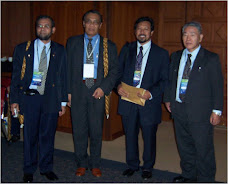
The Japan Society for the Promotion of Science (JSPS) Group 10 meeting was held in Penang recently (10 Feb 201o). Some of the member were there with the present of Japanese counterpart i.e. Prof Shuichi Hokoi, Prof Yuichiro Kodama and AP Dr. Takashi Kaneta.
Networking developed during the JSPS program since 2004 will be continued in the form of cooperation in research and academic activities.

Wednesday, February 10, 2010

EE campaign at Sekolah Islam Hidayah


Friday 5 Feb 2010, Energy Efficiency talks and campaign were organised at Sekolah Menengah Islam Hidayah JB (SMIH). Apart from the social activity, this is a 'project base learning' (PBL) of Climatic Architecture Technology (CAT) subject taught in Architecture Department FAB.
Attended about 500 students and 30 teachers of SMIH, 10 Architecture students and tutor of the CAT subject presented the talk entitle "Understanding Climate Change & Global Warming Phenomena" and "Energy Efficiency Practices in School".

As part of university students learning program, the EE campaign has an objective to help SMIH to reduce energy/electricity up to 10% from the current consumption. It will involve 'walk through energy audit' and continuous campaign on EE at school through collaborative effort and assistance by the tutor and students of CAT subject.

Thursday, January 7, 2010

Facts Impacts Climate Change

There are hard facts and impacts about climate change.
1. Climate change is strongly supported by hard science.
2. Our climate is changing rapidly , and at a rate faster than what we have experienced in all of human history.
3. By burning fossil fuels for electricity and other industries we are releasing billions of tons of carbon dioxide and changing the climate.
4. Carbon dioxide acts like a blanket, trapping the sun’s heat around the planet.
5. We can stop our carbon dioxide emissions and slow the rate of change.
6. We are not doing enough to reduce carbon dioxide emissions.
7. We must act now! 


The Impacts of Climate Change
Physical Impacts
1. Average global land and sea temperatures are rising.
2. The incidence of Droughts, wildfires and flooding are increasing globally. 

3. Glaciers and the permafrost are melting. 

4. Ice at the North and South Poles is melting and breaking up. 

5. Hurricanes, cyclones and typhoons are increasing in severity.
6. Fresh water resources are diminishing.

Social Impacts
1. People are already being displaced by rising sea levels. 

2. Agriculture and food supply is being affected by droughts. 

3. Countries are suffering loss of life, homes, and livelihoods from the increased severity of hurricanes, storms and flooding. 

4. Insurance costs are spiralling due to ‘natural’ damages.
5. Disease carrying insects are moving into new areas as temperature increases. Populations of other insects, like the pine beetle are exploding with devastating effect. 

6. Poorer countries like Africa will be amongst the most severely disadvantaged as they have few resources to adapt, and the regions are devastated by climate change.
7. Rivers have less regular flow, and water for drinking and crops is drying up.
8. The economic cost of NOT taking action is breathtaking.
Don’t despair! We can reduce our carbon emissions, but we must act now! Start with the 3 Step Climate Action Plan
Facts Impacts Climate Change
Read more from : http://www.global-greenhouse-warming.com/facts-impacts-climate-change.html
... and more from http://www.global-greenhouse-warming.com/climate.html

FACTS ABOUT ENERGY

World energy consumption is expected to increase 40% to 50% by the year 2010, and the global mix of fuels remains as; renewables (18%), nuclear (4%) and fossil (78%)
World energy consumption is projected to remain substantially the same as today, thus global carbon dioxide emissions would also increase 50% to 60%.
Fossil fuels are depleted at a rate that is 100,000 times faster than they are formed.
Worldwide, some 2 billion people are currently without electricity.
Developing countries use 30% of global energy. Rapid population growth, combined with economic growth, will rapidly increase that percentage in the next 10 years.
The World Bank estimates that investments of $1 trillion will be needed in this decade and upwards of $4 trillion during the next 30 years to meet developing countries' electricity needs alone.
According to Oil & Gas Journal (OGJ), Malaysia held proven oil reserves of 3.0 billion barrels as of January 2007, down from a peak of 4.6 billion barrels in 1996. The majority of the country’s oil reserves are located off the coast of peninsular Malaysia.
Approximately 30,000 lives are cut short in the U.S. each year due to pollution from electricity production. (ABT Associates study)
About 81 tons of mercury are emitted into the atmosphere each year as a result of electric power generation. Mercury is the most toxic heavy metal in existence. (U.S. Environmental Protection Agency)
Burning fossil fuels to produce energy releases carbon dioxide and other global-warming-causing gases into the atmosphere.
Global warming will increase the incidence of infectious diseases (including equine encephalitis and Lyme disease), death from heat waves, blizzards, and floods, and species loss. (Chivilan and Epstein, Boston Globe, April 10, 1997)
Human activities have caused a dramatic increase in the amount of carbon dioxide (CO2) in the earth's atmosphere. The main causes of increasing CO2 concentrations are the burning of fossil fuels — coal, petroleum products, natural gas — and deforestation.
Since about 1750, the concentration of CO2 has risen from about 280 parts per million by volume (ppmv) to reach 377 ppmv in 2004 — a value that has likely not been exceeded during the past 20 million years.
In 2000, CO2 emissions from fuel combustion have increased by approximately 10% compared with FY1990,
Carbon emissions in North America reached 1,760 million metric tons in 1998, a 38 % increase since 1970. They are expected to grow another 31 %, to 2,314 million metric tons, by the year 2020. (U.S. Department of Energy)
On average, 16 million tons of carbon dioxide are emitted into the atmosphere every 24 hours by human use worldwide.
1995 was the warmest year since global temperatures were first kept in 1856.
Emissions of carbon dioxide and other gases are causing global warming. (Chivilan and Epstein, Boston Globe)
The IPCC's Third Assessment Report (2001) concluded that if no explicit action is taken to curb GHG emissions from human activities, the global average surface temperature is projected to increase by 1.4 to 5.8°C between 1990 and 2100.
The global climate change is actually much more complicated than to a warmer summer, because a change in the temperature can cause changes in other weather elements such as clouds or precipitation.

Monday, December 14, 2009

THE WORLD'S LARGEST SOLAR OFFICE

The world's largest solar energy office building opened on November 27 in Dezhou, Shangdong Province in northwest China. The building, which has a total area of 75,000 square meters, features exhibition centers, scientific research facilities, meeting and training facilities, and a hotel.

The design of the building is based on the sun dial and underlines the urgency of seeking renewable energy sources to replace fossil fuels. The design also features the Chinese characters for sun "日" and moon "月", and the color white predominates, symbolizing clean energy.

Green ideas have been applied throughout the construction. The external structure of the building used only one percent of the steel used to construct the Bird's Nest. Advanced roof and wall insulation mean energy savings 30 percent higher than the national energy saving standard.

The building will be the main venue for the 4th World Solar City Congress. The building's ground-breaking solar energy and power-saving technologies, some of which have already been patented, include a number of technical advances that will push forward the mass application of solar energy.
http://www.inhabitat.com/2009/12/14/worlds-largest-solar-energy-office-building-opens-in-china/

Friday, October 16, 2009

FACTS ABOUT ENERGY EFFICIENCY

FACTS ABOUT ENERGY

· · Most commercial and industrial firms use energy more than they need.

· · Efficient use of energy means an increase in profit and business competitiveness.

· · Methods used to improve energy efficiency are wide ranging and easily implemented.

· · Improved energy efficiency leads to reduce environmental impact.

· · Energy is scarce resource, therefore its costs is ever increasing.

· · Adoption of a strategic Energy Management planning guarantees the sustainability of the drive for energy efficiency in an organisation.


WHY THE NEED FOR BETTER ENERGY MANAGEMENT IN YOUR FACILITIES

· · An opportunity to increase profit simply by reducing energy cost.

· · The industrial and commercial sectors remain the largest energy users.

· · Growth in energy cost in tandem with growth in business or production.

· · The ever increasing costs of energy.

· · Satisfy Government requirements for efficient use of energy by large energy users.

Copied from Eco Energy Web peg.